Explore the Industrial Wireless RS485 Modbus Transmitter Capabilities
The NCD Industrial Wireless RS485 Modbus Transmitter (PR55-88F) transforms Modbus devices into seamless wireless nodes, enabling effortless integration into the NCD wireless network and eliminating the need for cumbersome wired connections. .
Instead of relying on a central gateway to constantly request data, the Industrial Wireless RS485 Modbus Transmitter operates as the “Master” of its own RS485 loop. It bridges the gap between legacy hardware and modern wireless networks by operating autonomously on a user-defined schedule.
Features:
- Industrial Grade IoT Modbus RS485 To Wireless Converter
- Works With VFD, PLC, SCADA systems
- Works With HVAC Control Systems
- Ideal For MODBUS-RTU Communication Over Wireless
- Convert any RS485 Sensor/Device into a Wireless Sensor/Device
- API communication over Wireless for Robust Reliability
- Operating Temperature Range -40 to +85 °C
- 5V-24VDC Input Voltage Range
Choose the Modbus Transmitter if:
- You need Autonomous Monitoring: You want the device to wake up, read specific Modbus registers, and transmit them without the Gateway asking for it.
- You want a “Set it and Forget it” Setup: You prefer to configure the Slave ID, Baud Rate, and Registers once and have the device report data like a standard NCD wireless sensor.
- You are monitoring Remote Assets: Your application involves periodic data logging (e.g., every 15 minutes) for solar inverters, tank levels, or energy meters.
- You want Simple Integration: You want the Modbus data to arrive at the Gateway in a standard NCD sensor packet format (including firmware version and transmission counters) for easy decoding with NCD libraries.
Wireless Technology
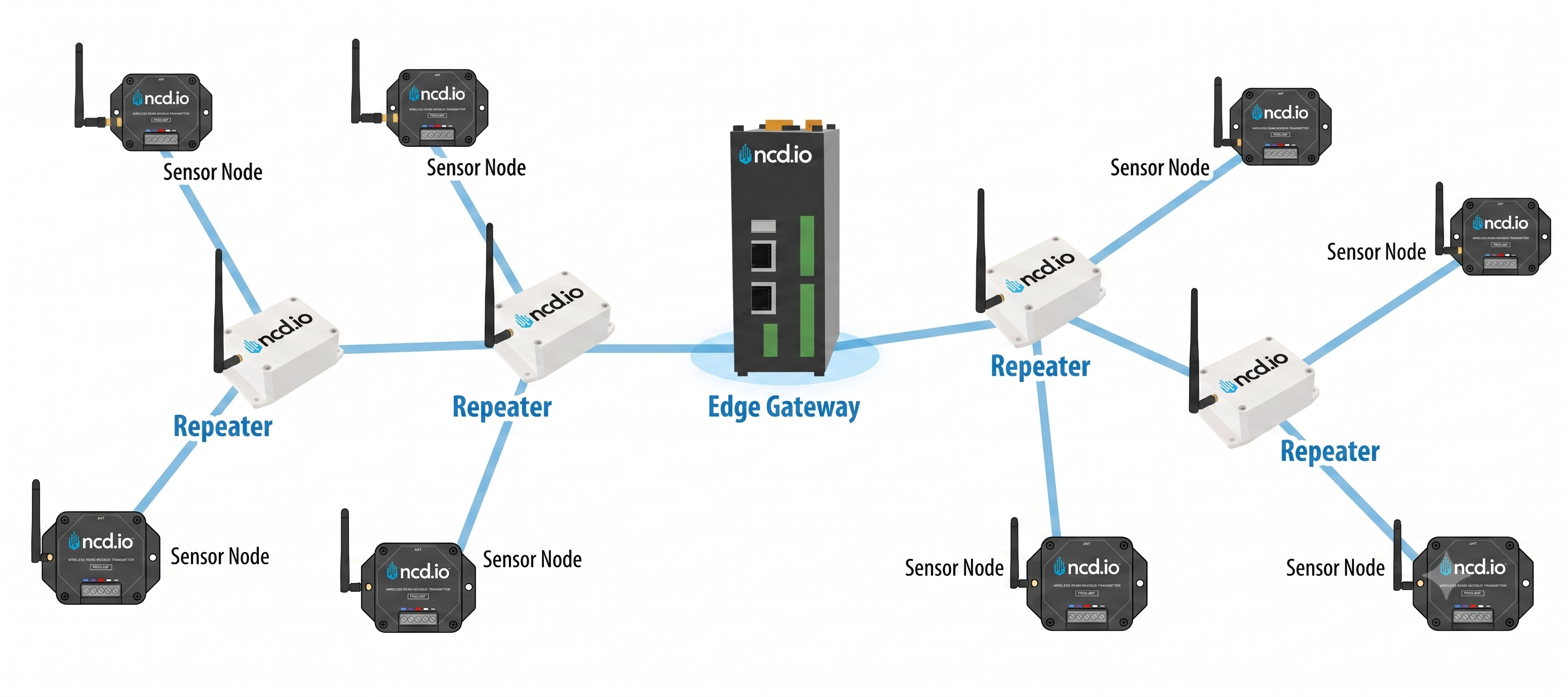
The NCD Industrial range of sensors utilizes DigiMesh, a proprietary networking technology designed by Digi® International. It is especially suitable for IIoT applications as it provides a number of benefits over conventional wireless stacks:
- Long range – up to 1000 feet in urban environments and 2 miles+ in open areas with the included antennas
- Mesh networking topology – no single point of failure, self healing network with high redundancy.
- Long battery life due to low power consumption – up to 10 years
- Simplified provisioning – extending the mesh network via repeater at no additional configuration complexity
- Works in the 868MHz, 900MHz and 2.4GHz bands – worldwide region interoperability.
If you want to learn more about DigiMesh and how it compares with another popular IoT stack (LoRaWAN) head to the article below:
IoT Wireless Sensor Networks: Digi®Mesh vs LoRaWAN®
Applications & Use-cases
Wireless Data Collection in Distributed Industrial Sites
The transmitter can be used in industrial environments where equipment is spread across a large area, such as mining operations, oil fields, or manufacturing plants. Instead of laying extensive RS485 cables, the transmitter allows for wireless data transmission, simplifying installation and reducing the cost of infrastructure. This enables centralized data collection and monitoring from multiple points within the facility.
Remote Monitoring of Legacy Industrial Equipment
The converter enables older industrial machines and equipment that use the RS485 Modbus communication protocol to be monitored remotely. By converting RS485 Modbus data into wireless signals, it allows these legacy systems to connect to modern Industrial IoT platforms, providing real-time data on operational status, performance, and potential issues without the need for costly retrofits or rewiring.
Integration of SCADA Systems with Wireless Networks
Supervisory Control and Data Acquisition (SCADA) systems often rely on RS485 communication for data exchange between sensors, controllers, and actuators. By integrating the RS485 to Wireless Converter, these traditionally wired systems can be upgraded to include wireless communication, enabling easier deployment, scalability, and data accessibility in remote or hard-to-reach locations.
RS485 to Wireless Converter Use-cases
Upgrading a Legacy Manufacturing Line to IoT
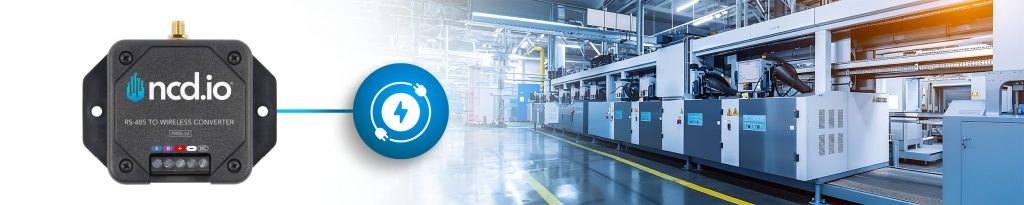
In an older manufacturing plant, several critical machines rely on Modbus RTU for communication but lack wireless connectivity. By installing the Modbus Transmitter on each machine, the plant can collect and transmit data wirelessly to a centralized IoT platform like Atrium Gateway. This upgrade enables real-time monitoring of machine performance, predictive maintenance, and seamless integration with modern automation systems without the need for expensive rewiring or equipment replacement.
Energy Management in a Large-Scale Industrial Facility
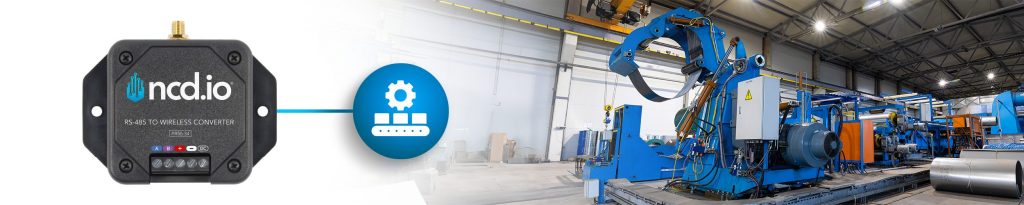
The Modbus Transmitter is used in an industrial complex where energy meters and power management systems communicate via Modbus RTU. By converting the RS485 signals to wireless, the facility can collect and analyze energy usage data from various points across the site in real time. This data helps in optimizing energy consumption, identifying inefficiencies, and reducing operational costs, all while simplifying the infrastructure by eliminating extensive cabling.
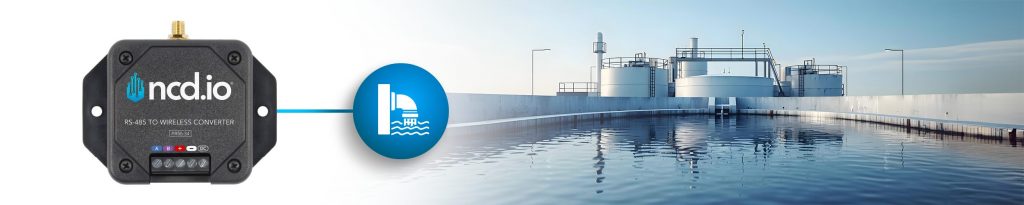
Remote Management of a Wastewater Treatment Plant
The Modbus Transmitter is deployed in a wastewater treatment facility where various pumps, valves, and sensors communicate using Modbus RTU. By converting this data to wireless, the facility can transmit real-time operational data to a central control room (Atrium Gateway) or cloud-based platform. This enables remote monitoring and management of the plant, ensuring that key processes are running smoothly and allowing for quick response to any detected issues, reducing the need for on-site personnel and improving overall efficiency.
Smart Agriculture with Distributed Sensor Networks
In a large agricultural operation, sensors and controllers for irrigation systems, soil monitoring, and weather stations communicate using Modbus RTU. The Modbus Transmitter allows these devices to transmit data wirelessly to a central system or cloud platform. This enables real-time monitoring and control of agricultural processes, enhancing crop management, optimizing resource use, and improving yields. The wireless capability also makes it easier to expand the sensor network as needed without additional wiring.