

Device Overview
NCD’s C1D2 certified long-range wireless sensor is engineered for comprehensive environmental monitoring, designed for hazardous environments. This advanced sensor measures temperature, humidity, pressure, air quality (IAQ), volatile organic compounds (VOC), and CO2 equivalent levels, making it an ideal solution for industrial, chemical, and explosive risk environments.
Certified under C1D2 Group A, B, C, and D, this sensor is suitable for use in areas where potentially explosive gases, dust, fibers, or flammable vapors are present, such as acetylene, hydrogen, gasoline, and propane. Industries such as oil and gas refineries, chemical plants, and mills can greatly benefit from its precise data collection and reliability.
- Long Range Industrial Wireless IoT Remote Temperature Humidity Sensor
- Industrial Grade with a Sensor Resolution of ±2%RH ±0.2°C
- Sensor Probe Operating Temperature Range: -40 to +125ºC
- Sensor Probe Operating Humidity Rating up to 90% Humidity
- CPU/Wireless module housing(box) Operating Temperature Range: -40 to +60ºC
- Wall-Mounted or Magnet Mounted IP65 Rated Enclosure
- Up to 2 Mile Line-of-Sight Range with On-Board Integrated Antenna
- For Use with Node-Red and NCD Industrial Gateways
- Wireless Mesh Networking using DigiMesh®
- Open Communication Protocol for Easy Software Integration
- Power-Efficient Sleep Mode, Up to 10 Year Battery Life
- User Configurable Sleep duration
- Includes Battery Level with Every Transmission
- Validates and Retries Lost Communication Packets
Status LED
The Status LED is used to indicate errors or other sensor diagnostics.
LED blinks once – Message was sent successfully and no error in last sensor read as well in data transmission.
LED blinks twice and then one more time – Message was sent successfully but there was an error in last sensor read.
LED blinks thrice – MCU is having issue communicating with the radio module.
Sensor Specifications
| Specifications | Minimum | Nominal | Maximum | Notes |
|---|---|---|---|---|
| Width | 3.54" | |||
| Length | 4.52" | |||
| Height | 2.16" | |||
| Enclosure Rating | IP65, NEMA 1,2,4,4X,12,13, UL-508 | |||
| Temperature Rating | -40° C | 23° C | 85° C | Component Rating |
| Tested Temperature | 0° C | 23° C | 40° C | As Tested by NCD Staff |
| Probe Temperature | -40° C | 23° C | 105° C | As Tested by NCD Staff |
| Temperature range | -25°C [-13°F] | 85°C [185°F] | ||
| Temperature resolution | 0.025°C | |||
| Temperature accuracy | 0.3°C | |||
| Relative Humidity range | 0 % | 100 % | ||
| Relative Humidity resolution | 0.04% | |||
| Relative Humidity accuracy | 2% |
Printed Circuit Board Specifications
| Parameter | Minimum | Nominal | Maximum | Notes |
|---|---|---|---|---|
| Trace Width | 0.007 inch | 0.012 inch | 0.25 inch | Trace Width depends on the Trace Type |
| Layer Count | 2L - Rigid | Top and Bottom Layer | ||
| Material Type | FR-4 TG170 | FR-4 TG170 | FR-4 TG180 | |
| Surface Finish | ENIG 2u" | |||
| IPC Standard | IPC CLASS 2 | |||
| Finished Copper Foil | 1.0/1.0 OZ | |||
| Finished Thickness | 0.062 inc | |||
| Fine line <4.0/4.0mil | No | |||
| Blind & Burried Vias | No | |||
| Non-Conductive Resin | No | |||
| Conductive Resin | No |
Mechanical Drawing

RF Module Specifications
| Parameter | 868MHz | 900MHz | 2.4GHz |
|---|---|---|---|
| Frequency Band | 863 MHz to 870 MHz | 902 to 928 MHz | ISM 2.4 GHz |
| Transmitter Power | Up to 13 dBm ERP | Up to 24 dBm | Up to 8 dBm |
| Receiver Sensitivity | -106 dBm at 80 Kbps | -101 dBm at 200 Kbps | -103 dBm at 250 Kbps |
| Range (dense urban) | ~1000ft | ~1000ft | ~300ft |
| Range (line of sight) | ~2 miles | ~2 miles | ~1 mile |
| Data Rate | 80 Kbps | 200 Kbps | 250 Kbps |
| Networking Protocol | Digi XBee® DigiMesh® | Digi XBee® DigiMesh® | Digi XBee® DigiMesh® |
| Encryption | 128-bit AES | 128-bit AES | 128-bit |
| Reliable Packet Delivery | Retries/acknowledgements | Retries/acknowledgements | Retries/acknowledgements |
| IDs | PAN ID and addresses, cluster IDs and endpoints (optional) | PAN ID and addresses, cluster IDs and endpoints (optional) | PAN ID and addresses, cluster IDs and endpoints (optional) |
| Certification | CE/RED, ROHS Compliant | FCC (America), IC (Canada), C-Tick (Australia), Anatel (Brazil), IDA (Singapore) | FCC (America), IC (Canada), RCM (Australia), Anatel (Brazil), Teleck MIC (Japan), KCC (South Korea) |
Power Requirements and Expected Battery Life
Power Requirements
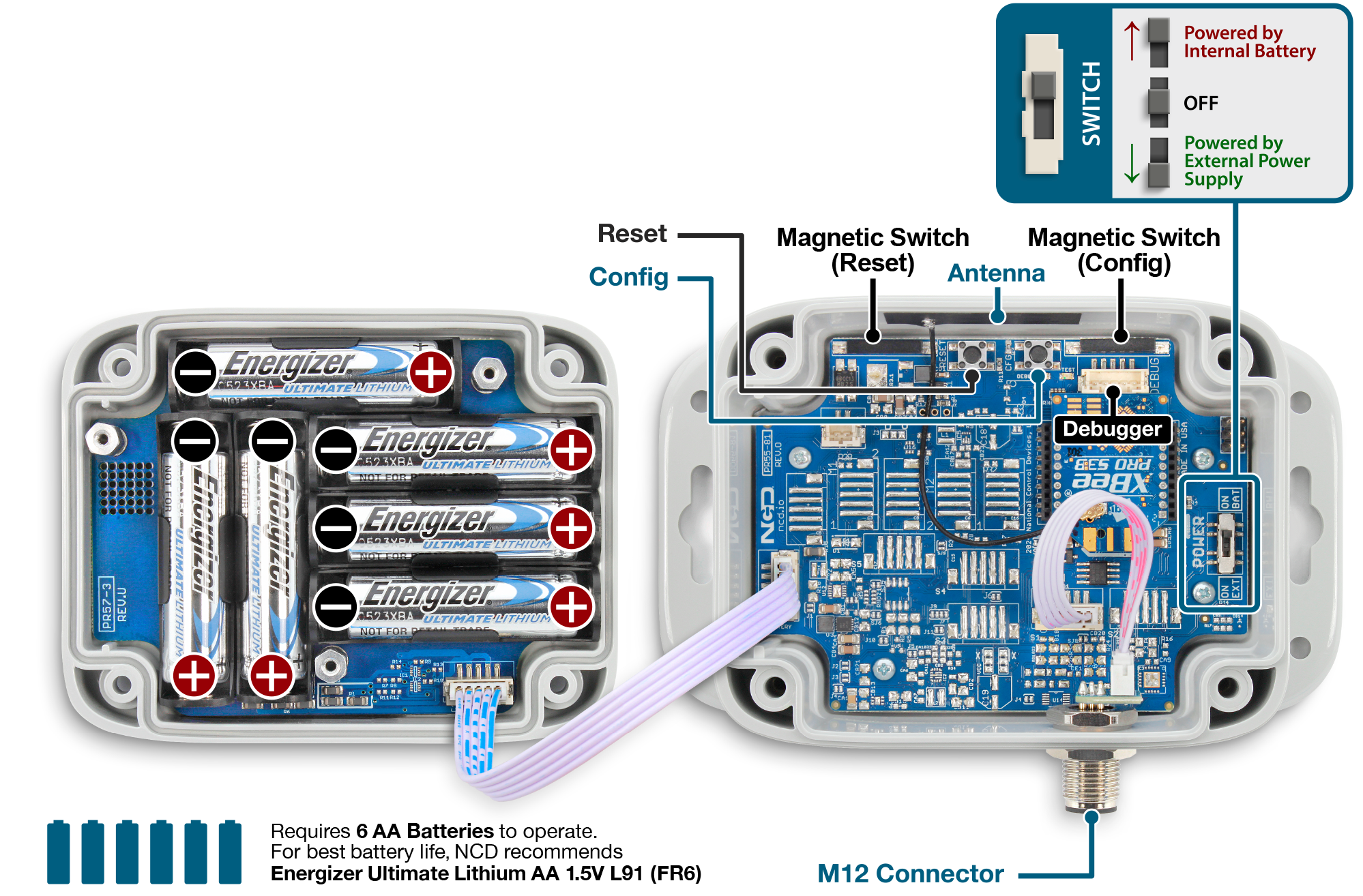
This sensor is powered by AA batteries (NCD recommends Energizer L91 batteries)
While changing the batteries:
- Turn off the sensor
- Only use new L91 batteries
- Checkout the polarity marking on the battery holder and batteries
- Replace all six batteries with new L91 batteries. Do not mix old and new batteries
- The battery should not be replaced in or near hazardous/combustible environments or materials.
- Do NOT install rechargeable batteries
Expected Battery Life
| Specifications | Minimum | Nominal | Maximum | Notes |
|---|---|---|---|---|
| Batteries | 2 | 4 | 4 | May be Powered by 2 or 4 AA Batteries |
| Battery Life 6 TPD (TPD Transmissions per Day) | 8 Years | Battery estimation is based on a 30 min interval | ||
| Battery Life 12 TPD (TPD Transmissions per Day) | 5 Years | Battery estimation is based on a 30 min interval | ||
| Battery Life 24 TPD (TPD Transmissions per Day) | 3 Year | Battery estimation is based on a 30 min interval |
Head to the NCD store if you want to purchase the C1D2 Hazardous Environment Air Quality Sensor.
If you already have the device and would like more information into its basic and advanced operations check out the Quick Start Guide and User Manual.