

Start with the fault you want to catch. The specs follow from that.
A wireless vibration sensor bolts or magnets onto a motor, pump, fan or gearbox, measures how the machine shakes, and sends those readings over radio to a gateway. Predictive maintenance is the practice of watching those readings change over weeks so you can plan a repair before the machine fails. Picking the right sensor comes down to a handful of questions about your machines, and this guide walks through them in order.
The short answer
For general motors, pumps and fans, choose a 3-axis sensor with on-board FFT and temperature. For bearings you can’t afford to lose, add ultrasound. Before you buy, check how it mounts, how far it transmits, how long the battery lasts and where the data goes.
What faults are you trying to catch?
The fault decides how much frequency range you need.
Lower frequencies
Imbalance, misalignment and looseness
These show up at the machine’s running speed and its first few multiples. Overall vibration (RMS velocity) and an FFT spectrum up to a few kilohertz catch them well.
Higher frequencies
Early bearing wear and poor lubrication
These start well above the vibration band, before they show up as vibration at all. Ultrasound sensing picks them up earlier.
For a general fleet of motors and pumps, a 3-axis accelerometer with on-board FFT covers the common mechanical faults. For bearings you can’t afford to lose, add ultrasound.
Which specs actually matter?
These are the numbers worth comparing between sensors, and what each one tells you.
Where does the sensor need to mount?
Mounting decides between a one-piece sensor and one with an external probe. A one-piece sensor mounts directly on the machine and is the quickest install. An external probe puts the accelerometer right on the bearing housing while the battery and radio sit somewhere you can reach. That matters for tight spaces, guarded shafts and hot surfaces.

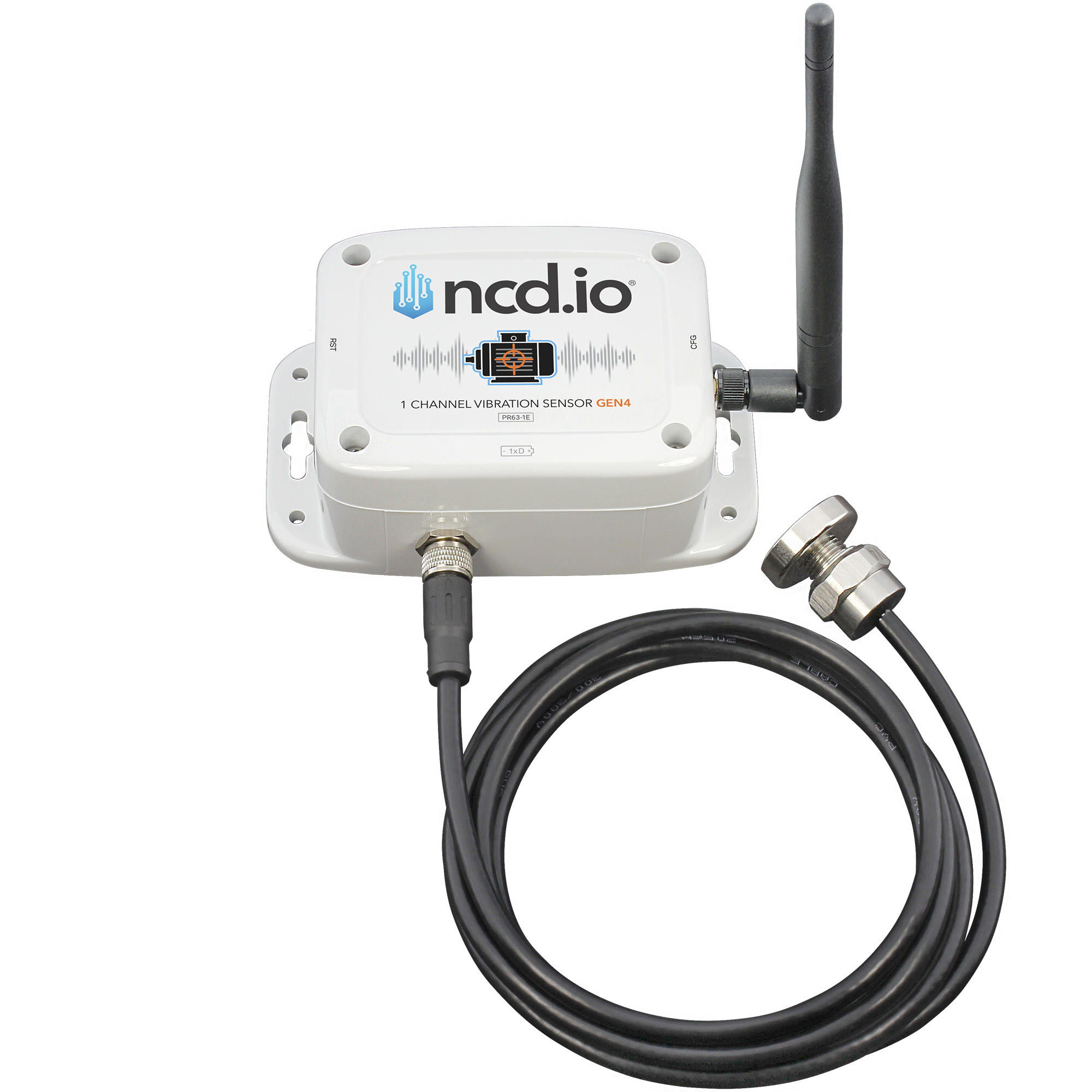
The probe itself is a small metal body on a shielded cable. It threads into a tapped hole on the bearing housing, or screws onto a magnet base when you can’t drill. On the V3 sensors the thread is 1/4 NPT or 1/4-28 UNF. A threaded mount gives the cleanest reading, and the magnet is the quick way to start or to try a few spots.


Check the enclosure rating against the environment. The Gen4 Smart Vibration Sensor is a sealed IP67 unit for washdown and wet areas. The probe models use an IP65 main enclosure.
How far does the signal need to travel?
Range decides how many gateways you need. NCD sensors use a self-healing wireless mesh on 868 MHz / 900 MHz / 2.4 GHz, with up to 2 miles line-of-sight on the 900 MHz band. Inside a plant, walls, steel and equipment shorten that, so plan on much less indoors. Because it’s a mesh, sensors relay readings for each other, and a far corner of the building can still reach the gateway.
How long will the battery last?
Battery life depends on how often the sensor reports. NCD’s Gen4 vibration sensors are rated for up to 5 years. Reporting every few minutes uses more battery than reporting a few times a day, so set the interval to match how fast the machine can change.
Where does the data go?
Decide this before you buy, because it sets your ongoing cost. Some vibration systems send data to the vendor’s cloud and charge a monthly fee per sensor. NCD sensors report to the Atrium gateway, which stores readings on your own network and sends alerts with no monthly fee. The gateway can also forward data to AWS, Azure, MQTT brokers or Node-RED, so it fits into a CMMS or historian you already run.
Which NCD vibration sensor fits which job?
Each card starts with the job, then names the sensor built for it.
General monitoring, quickest install
Gen4 Smart Vibration Sensor
One sealed IP67 unit with 3-axis vibration and temperature, sampling at up to 25.6 kHz. For motors, pumps and fans.
Tight, guarded or hot spots
Gen4 Vibration Temperature Sensor
An external mounting probe puts the accelerometer on the bearing housing. On-board FFT, IP65 main enclosure.

Tight, guarded or hot spots (V3 line)
V3 Vibration Temperature Sensor
One external probe on a 2 m shielded cable that threads in (1/4 NPT or 1/4-28 UNF) or mounts by magnet. Time-domain data plus on-board FFT.
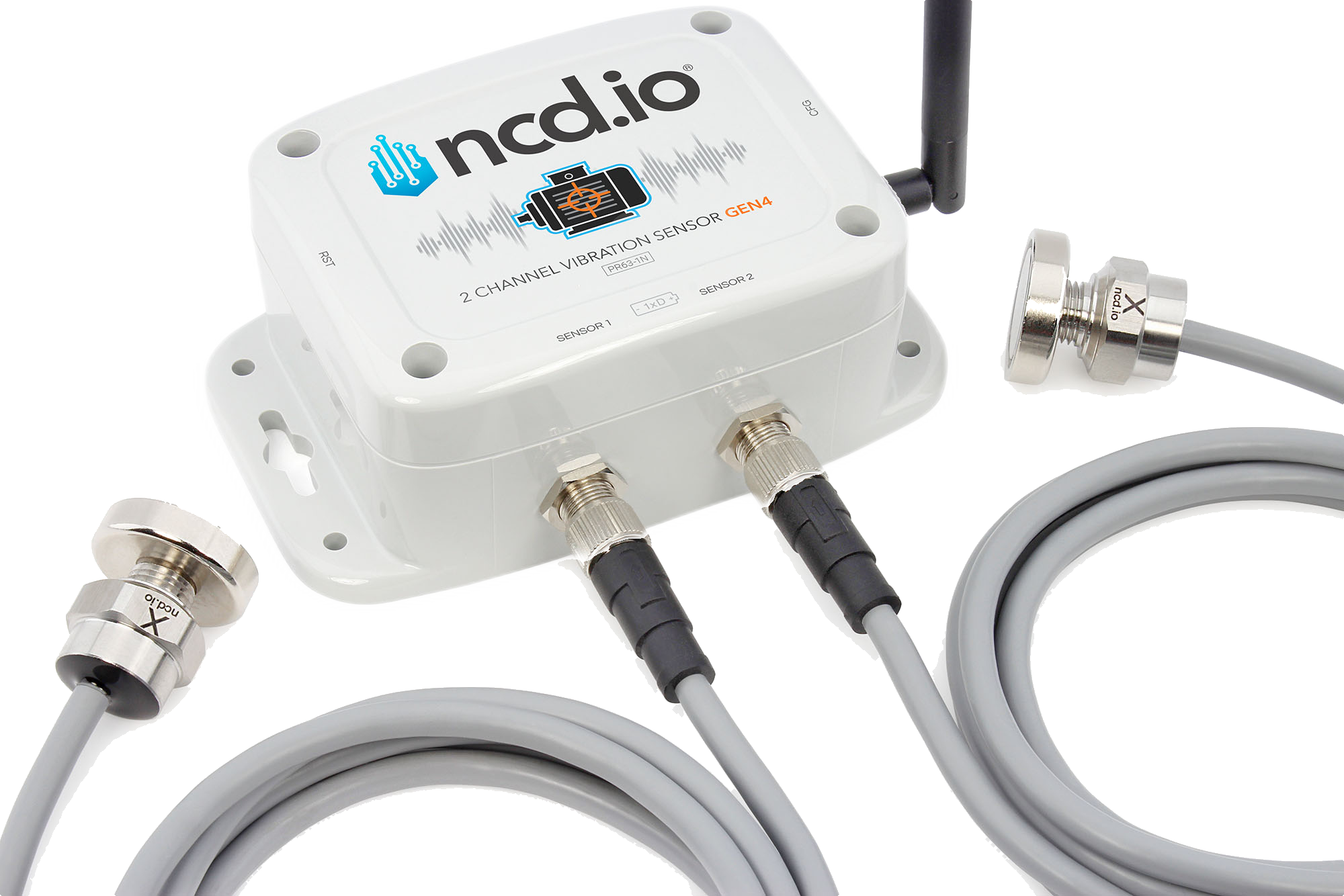
Two points on one machine
Gen4 2-Channel Vibration Temperature Sensor
Two vibration probes reporting through one box, for the motor end and the pump end.

Two points on one machine (V3 line)
V3 2-Channel Vibration Temperature Sensor
A pair of external probes, each rated -40 to +125 °C, with threaded or magnet mounting and on-board FFT.
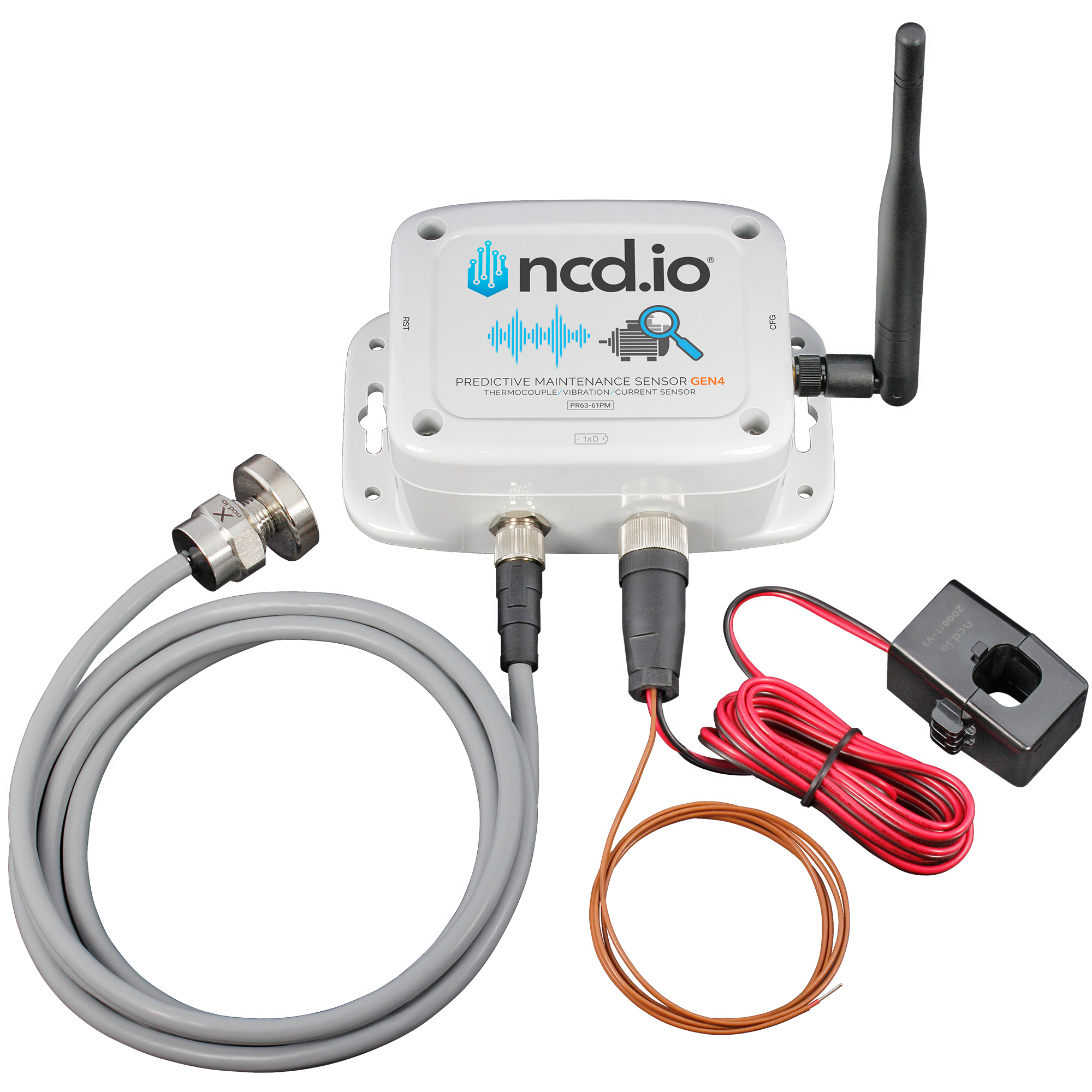
Vibration plus heat and load
Gen4 Predictive Maintenance Sensor
Vibration with FFT, a K-type thermocouple to 260 °C (500 °F) and AC current through a clamp-on CT.
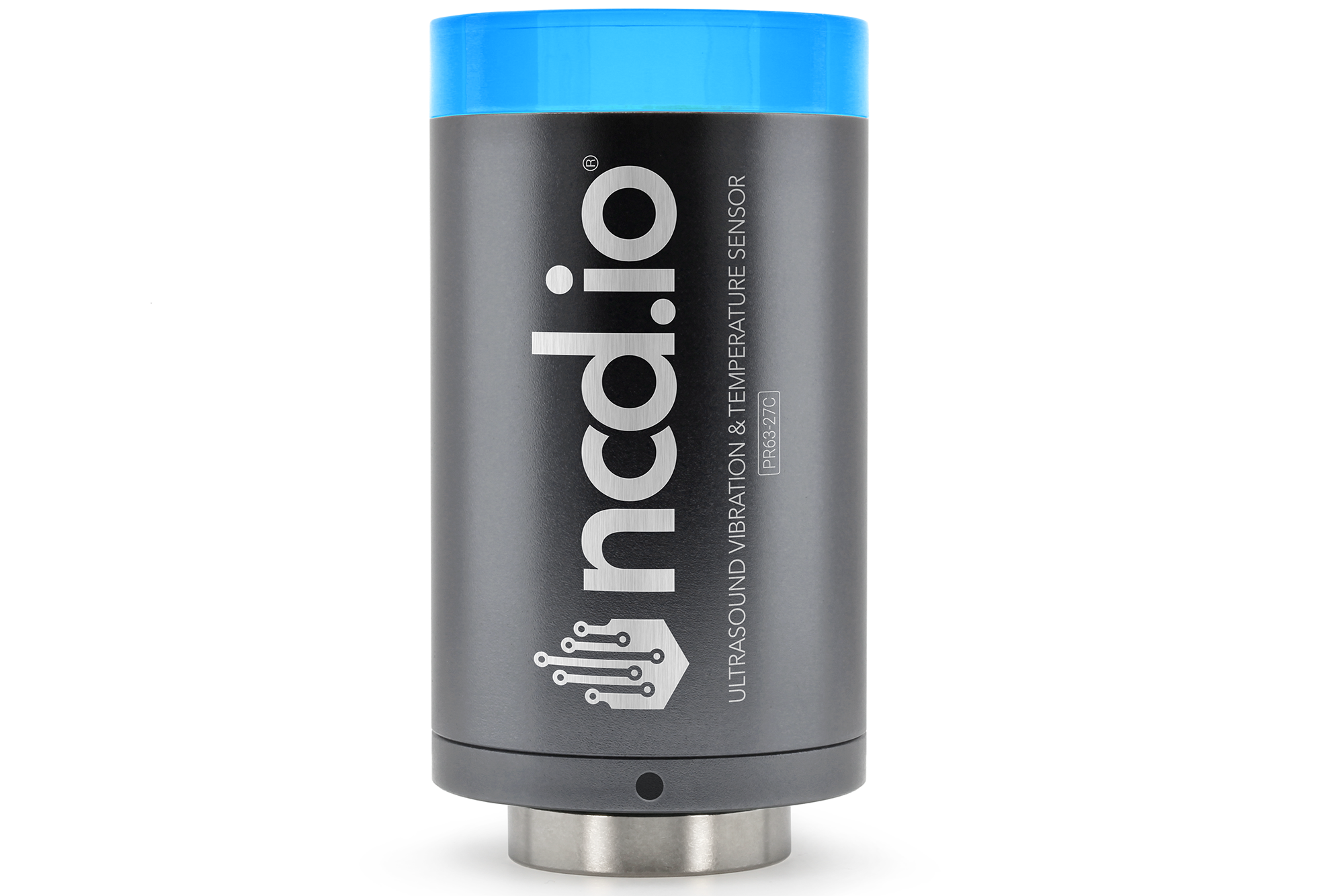
Early bearing and lubrication problems
Gen4 Ultrasound Vibration Sensor
Ultrasound sampled at up to 82 kHz (30–120 dBµV) alongside 3-axis vibration.

Hazardous locations
V3 C1D2 Vibration Temperature Sensor
Rated Class I, Division 2, Groups A–D, with on-board FFT.
The Predictive Maintenance Sensor is worth a closer look on motors. Current draw shows what a fault is doing to the load, and a slipping belt shows up as a drop in current.
How should you roll it out?
Start with the machines that would hurt most if they stopped, like a pump with no spare or a motor that shuts down a whole line. Put sensors on those first and let them collect two to four weeks of normal running. That gives you a baseline, and every alert after that compares against what normal looks like for that machine.
Set alarms on change from the baseline as well as fixed limits. A pump that always runs at 4 mm/s and jumps to 6 mm/s deserves a look, even if 6 mm/s is fine for a different pump.
Frequently asked questions
What is the best wireless vibration sensor for predictive maintenance?
The best one is the sensor that catches the faults your machines actually have and sends data somewhere your team will look at it. For general motors, pumps and fans, a 3-axis sensor with on-board FFT and temperature covers the common mechanical faults. For critical bearings, add ultrasound.
Do I need a 3-axis vibration sensor?
Yes for most rotating equipment. Faults show up on different axes (misalignment is often strongest along the shaft), and a 3-axis sensor reads all of them from one mounting point.
How long do wireless vibration sensor batteries last?
NCD’s Gen4 vibration sensors are rated for up to 5 years. The real number depends on how often the sensor reports.
How far can a wireless vibration sensor transmit?
NCD sensors reach up to 2 miles line-of-sight on the 900 MHz band, and sensors relay for each other in a mesh. Indoors, walls and equipment shorten the range.
Is there a wireless vibration sensor for hazardous locations?
Yes. NCD’s V3 C1D2 Vibration Temperature Sensor is rated Class I, Division 2, Groups A, B, C and D.
What is the difference between vibration and ultrasound monitoring?
Vibration monitoring measures how the machine moves and catches imbalance, misalignment and looseness. Ultrasound picks up high-frequency friction and impacts inside a bearing, which show up earlier in the bearing’s wear.
Do wireless vibration sensors need a monthly subscription?
Some do. NCD sensors report to the Atrium gateway, which keeps data on your network with no monthly fee.
Still have a question?
Ask about your specific machine on the NCD Community forum.