

Explore the Wireless Vibration, Ultrasound and Temperature Sensor Capabilities
Device Overview
Introducing NCD’s Wireless Vibration, Ultrasound and Temperature Sensor. Engineered for industrial predictive maintenance. They track 3-axis acceleration, vibration severity (RMS/Peak), temperature, and RPM. By capturing data up to 25.6kHz, they help detect mechanical faults (e.g., bearing wear, imbalance) before unexpected machine failures occur it also integrated ultrasound capabilities to capture high-frequency acoustic emissions.
This addition is critical because ultrasound detects the earliest stages of friction, lubrication starvation, and potential leaks long before detectable vibrations or temperature spikes occur. By combining both technologies, the sensor provides comprehensive visibility across the entire equipment degradation curve, allowing your team to identify and resolve anomalies weeks or months earlier than relying on vibration analysis alone.
Features:
- It Helps to Detect: Misalignment, Looseness, Imbalance, Bearing wear, Gearbox wear, Lubrication.
- Senses Vibration, Ultrasound and Temperature.
- Analyzes On-Device: FFT, Time-Domain Data, Overall, RPM, Uptime.
- Always-Listening Mode: Stays on to capture machines that cycle on and off.
- Small & lightweight for ease of installation.
- IP67 rated sealed enclosure for dust &
moisture protection. - D-cell battery for long-lasting operation.
- A versatile user-configurable sample rate for slow or fast-running machines.
- In-Built Machine Learning optimizes power consumption.
- Asset On-Time Calculator automatically tracks operational status.
- Hardware Accelerator enhances vibration sampling accuracy.
- Configurable Sample Rate – 100Hz to 25.6KHz
- Available Wireless Transmission Frequencies – 900Mhz, 868Mhz, and 2.4Ghz
- Supports MESH networking via DigiMesh
- Fully open Node-RED library for configuration and data ingestion
- No Monthly Cost.
- Total Data Owner Ship.
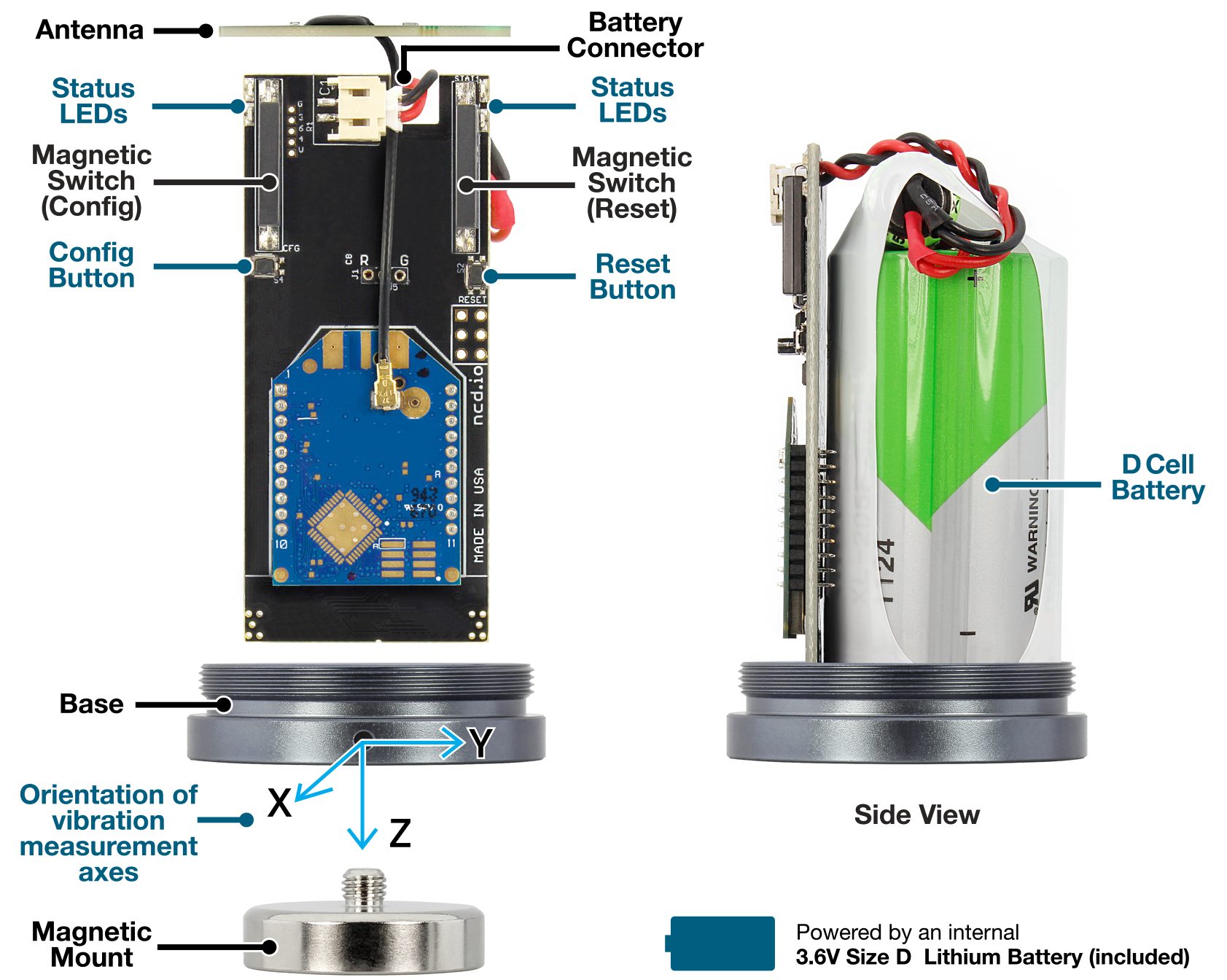
Status LED
The Status LED is used to indicate errors or other sensor diagnostics.
LED blinks once – Message was sent successfully and no error in last sensor read as well in data transmission.
LED blinks twice and then one more time – Message was sent successfully but there was an error in last sensor read.
LED blinks thrice – MCU is having issue communicating with the radio module.
Sensor Specifications
| Specifications | Minimum | Nominal | Maximum | Notes |
|---|---|---|---|---|
| Height | 85mm | |||
| Base diameter | 48mm | |||
| Weight | 225g | |||
| Enclosure Rating | IP67 | |||
| Mounting | ¼-28 UNF thread Magnetic mount | |||
| Temperature Rating | -40° C | 23° C | 70° C | Component Rating |
| Tested Temperature | 0° C | 23° C | 40° C | As Tested by NCD Staff |
| Temperature Sensor Accuracy | ±1°C | |||
| Accelerometer Sampling Rate | 25.6 kHz | Vibration Sensor Data Rate | ||
| Accelerometer Full-Scale Range | -16g | +16g | ||
| Accelerometer Noise | 70 μg/ √Hz | |||
| Ultrasound Full Scale Range | 30dBuV | 120dBuV | 120dBuV | |
| Ultrasound Sample rate | 83KHz | |||
| Support Ultrasound Time Domain data Max Sample | 16384 | |||
| Sample Duration | 1sec | 1sec | 10sec | Device will take readings for the set time and then send over wireless. Max numbers 8100. |
Printed Circuit Board Specifications
| Parameter | Minimum | Nominal | Maximum | Notes |
|---|---|---|---|---|
| Trace Width | 0.007 inch | 0.012 inch | 0.25 inch | Trace Width depends on the Trace Type |
| Layer Count | 2L - Rigid | Top and Bottom Layer | ||
| Material Type | FR-4 TG170 | FR-4 TG170 | FR-4 TG180 | |
| Surface Finish | ENIG 2u" | |||
| IPC Standard | IPC CLASS 2 | |||
| Finished Copper Foil | 1.0/1.0 OZ | |||
| Finished Thickness | 0.062 inc | |||
| Fine line <4.0/4.0mil | No | |||
| Blind & Burried Vias | No | |||
| Non-Conductive Resin | No | |||
| Conductive Resin | No |
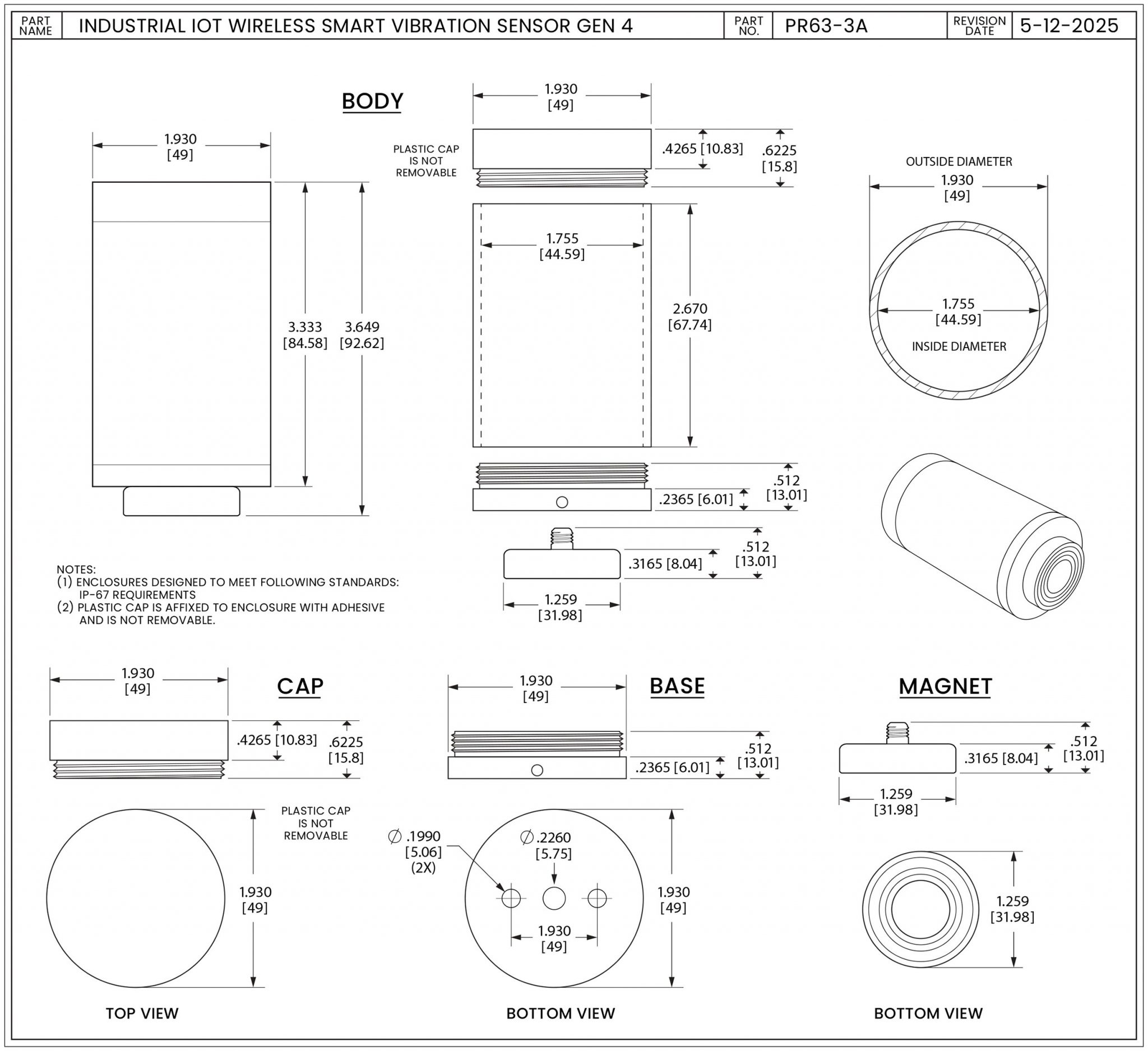
Mechanical Drawing
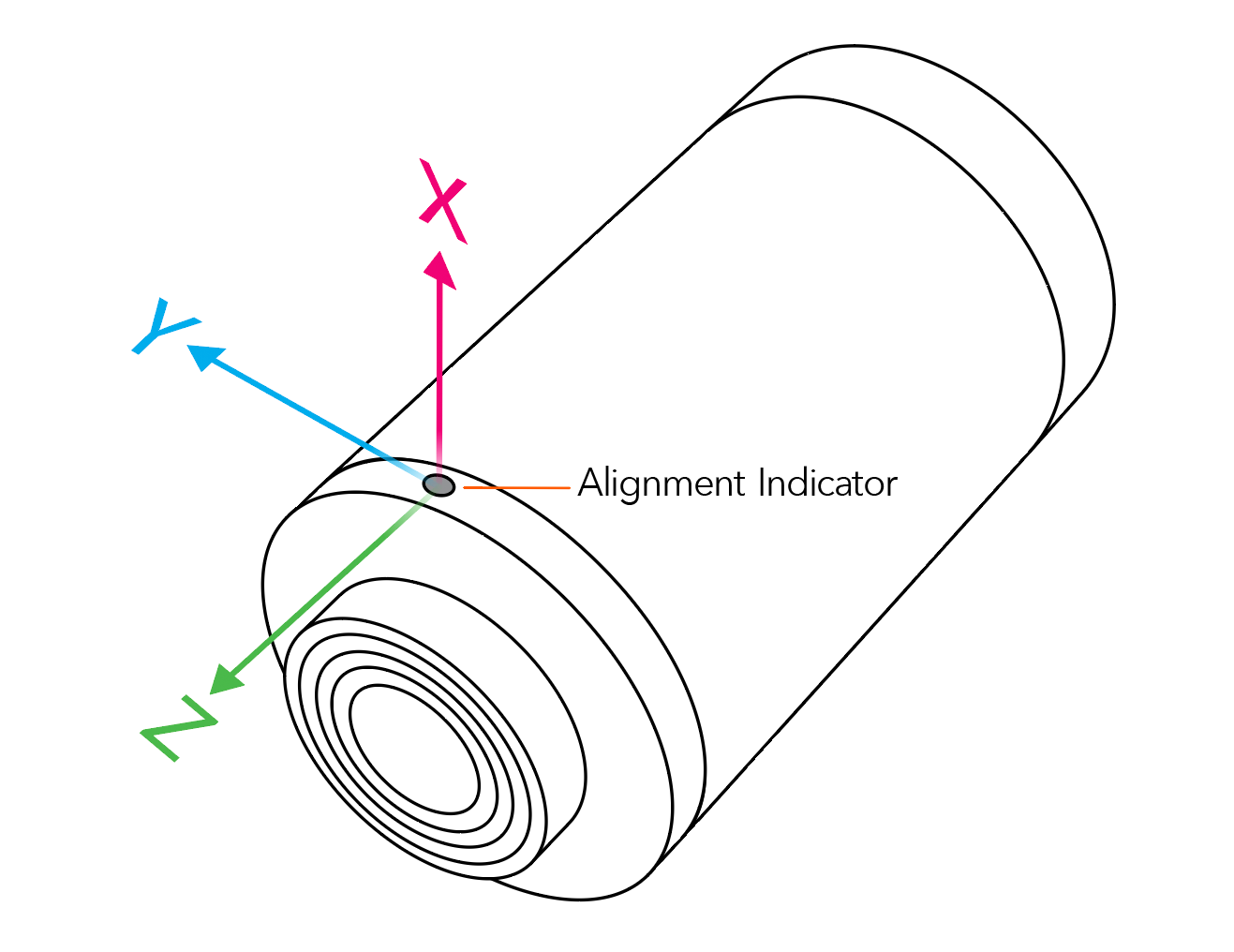
Alignment Indicator
RF Module Specifications
| Parameter | 868MHz | 900MHz | 2.4GHz |
|---|---|---|---|
| Frequency Band | 863 MHz to 870 MHz | 902 to 928 MHz | ISM 2.4 GHz |
| Transmitter Power | Up to 13 dBm ERP | Up to 24 dBm | Up to 8 dBm |
| Receiver Sensitivity | -106 dBm at 80 Kbps | -101 dBm at 200 Kbps | -103 dBm at 250 Kbps |
| Range (dense urban) | ~1000ft | ~1000ft | ~300ft |
| Range (line of sight) | ~2 miles | ~2 miles | ~1 mile |
| Data Rate | 80 Kbps | 200 Kbps | 250 Kbps |
| Networking Protocol | Digi XBee® DigiMesh® | Digi XBee® DigiMesh® | Digi XBee® DigiMesh® |
| Encryption | 128-bit AES | 128-bit AES | 128-bit |
| Reliable Packet Delivery | Retries/acknowledgements | Retries/acknowledgements | Retries/acknowledgements |
| IDs | PAN ID and addresses, cluster IDs and endpoints (optional) | PAN ID and addresses, cluster IDs and endpoints (optional) | PAN ID and addresses, cluster IDs and endpoints (optional) |
| Certification | CE/RED, ROHS Compliant | FCC (America), IC (Canada), C-Tick (Australia), Anatel (Brazil), IDA (Singapore) | FCC (America), IC (Canada), RCM (Australia), Anatel (Brazil), Teleck MIC (Japan), KCC (South Korea) |
Power Requirements and Expected Battery Life
Power Requirements
This device is Powered by a single D-cell (LR20) battery
While changing the batteries:
- Turn off the sensor
- Only use a new D-cell battery (obtain one from NCD, as it has a built in supercapacitor, this is not a regular battery).
- Make sure to align the connector in the proper orientation (this will assure you match the polarity)
- The battery should not be replaced in fire-risky areas
- Do NOT install a rechargeable battery
Expected Battery Life
| Specifications | Minimum | Nominal | Maximum | Notes |
|---|---|---|---|---|
| Batteries size | 16000mAh | This device has a single D-Cell (LR20) battery | ||
| Battery Life 1 TPD | 10 Years | TPD Transmissions per Day | ||
| Battery Life 12 TPD | 8 Years | TPD Transmissions per Day | ||
| Battery Life 24 TPD | 5 Year | TPD Transmissions per Day | ||
| Battery Life 96 TPD | 3 Year | TPD Transmissions per Day |