
Introduction
This guide aims to explain the core functionality and architectural differences between our PR55-34 and PR55-88F Industrial RS485 IoT devices. While both units are built for industrial environments and share a similar form factor, they are optimized for distinct IIoT applications.
RS-485 To Wireless Converter
RS485 Modbus Transmitter
In the following sections, we will perform a deep dive into their technical specifications, provide real-world application examples, and outline the specific benefits of each model. By the end of this guide, you will have a comprehensive understanding of which device is best suited for your particular requirements.
Industrial IoT RS485 To Wireless Converter (PR55-34)
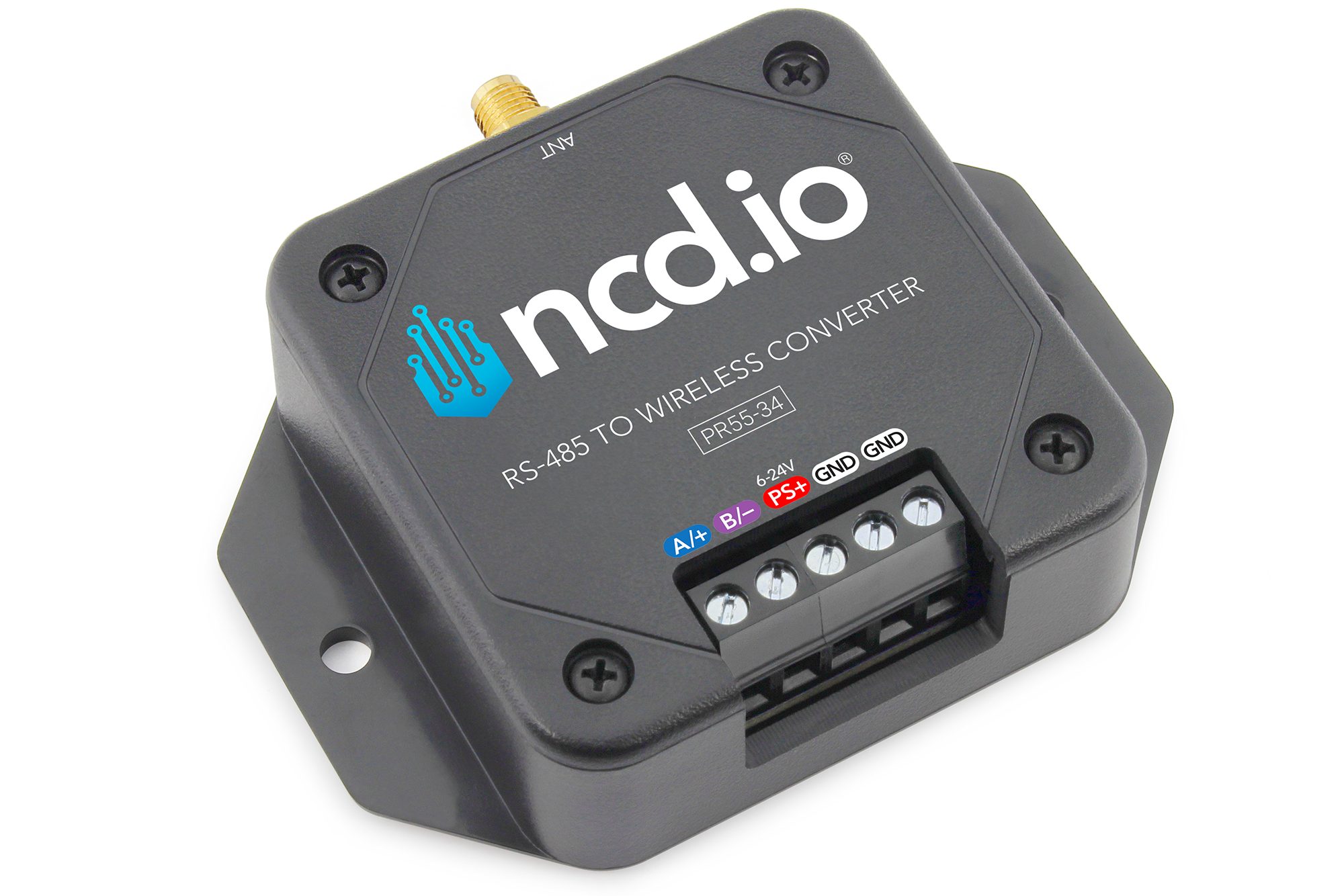
In industrial environments, wires are often the enemy. They are expensive to run, prone to physical damage, and limited by distance. The PR55-34 Industrial IoT RS485 to Wireless Converter is the “Swiss Army Knife” of serial communication, designed to eliminate these wires while maintaining industrial-grade reliability.
The PR55-34 is a bidirectional bridge. It doesn’t just send data; it translates between the wired world of RS485 and the long-range world of 900MHz/868MHz/2.4GHz wireless.
1. The "Wireless Cable": RS485 to RS485 Bridge
Best for: Replacing long, expensive, or impossible cable runs between two serial devices.
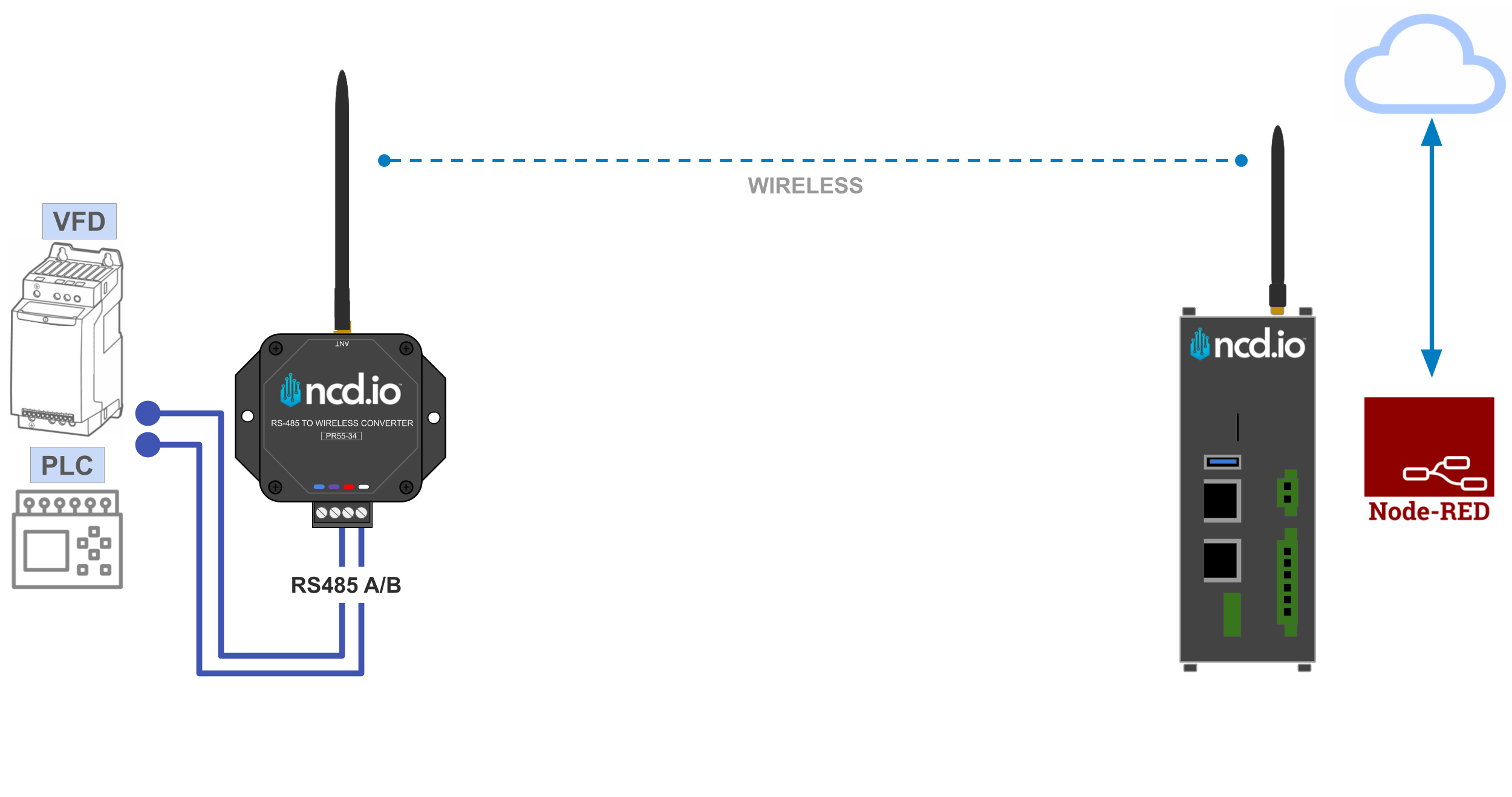
If you have two devices (like a PLC and a remote VFD) that need to talk to each other via RS485, you would normally have to run a twisted-pair cable between them. With two PR55-34 units, you can “cut the cord.”
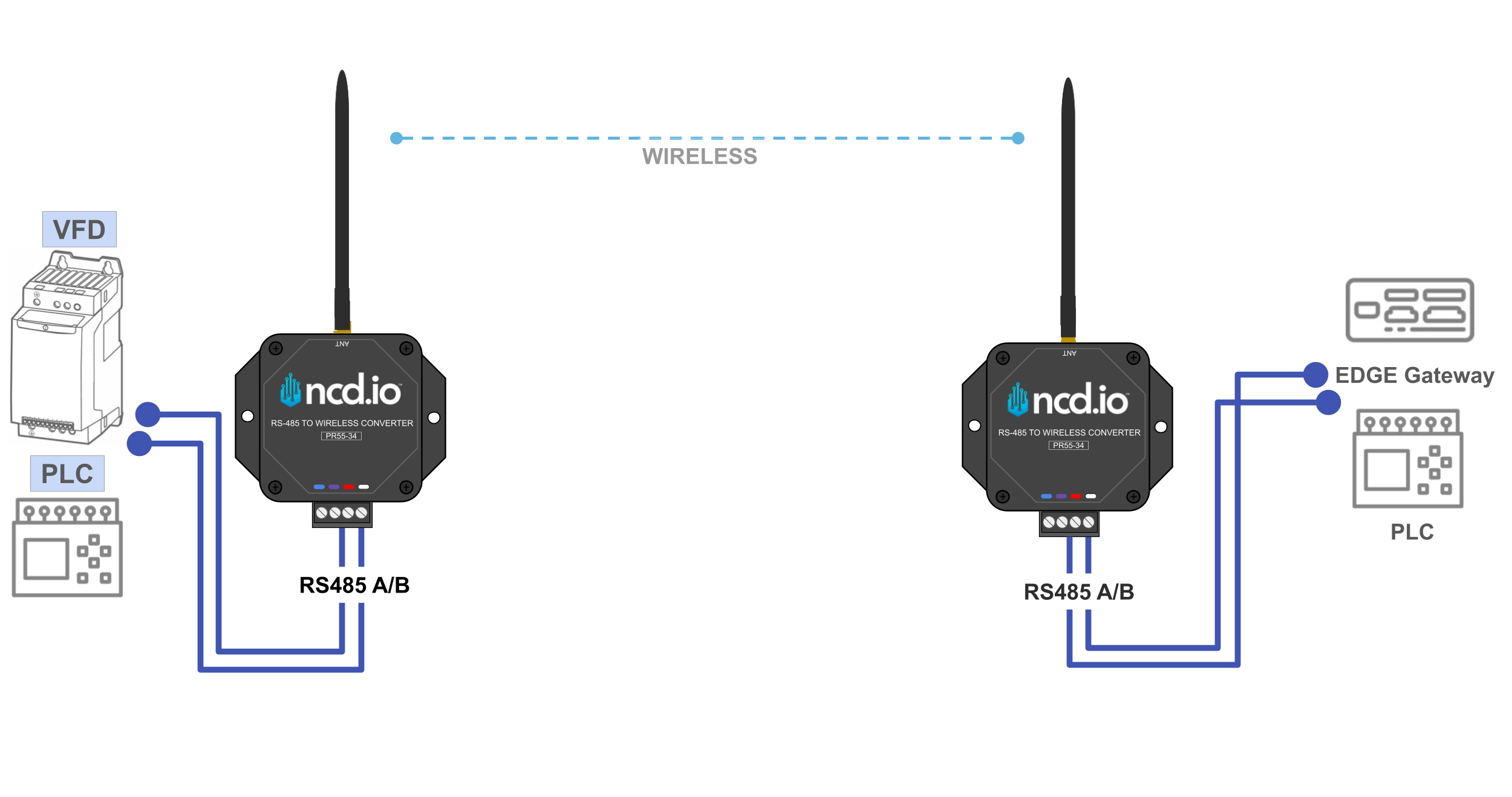
How it works: One unit connects to Device A, and the second unit connects to Device B. The wireless link acts as a transparent virtual cable.
The Benefit: You save on conduit, labor, and troubleshooting physical wire breaks. With a long Wireless range, it reaches where cables can’t.
Wireless USB Modem
2. The Modernizer: Making Legacy RS485 Devices Wireless
Best for: Bringing old sensors or Modbus RTU devices into a modern Industrial IoT protocol.
Do you have a 10-year-old RS485 flow meter that isn’t wireless? The PR55-34 can “wrap” that legacy device in a wireless bubble, allowing it to communicate with a central NCD Gateway.
How it works: You connect the PR55-34 to your legacy sensor. From your central computer (using Node-RED), you send a Modbus command wirelessly. The PR55-34 receives it, passes it to the sensor, grabs the response, and beams it back.
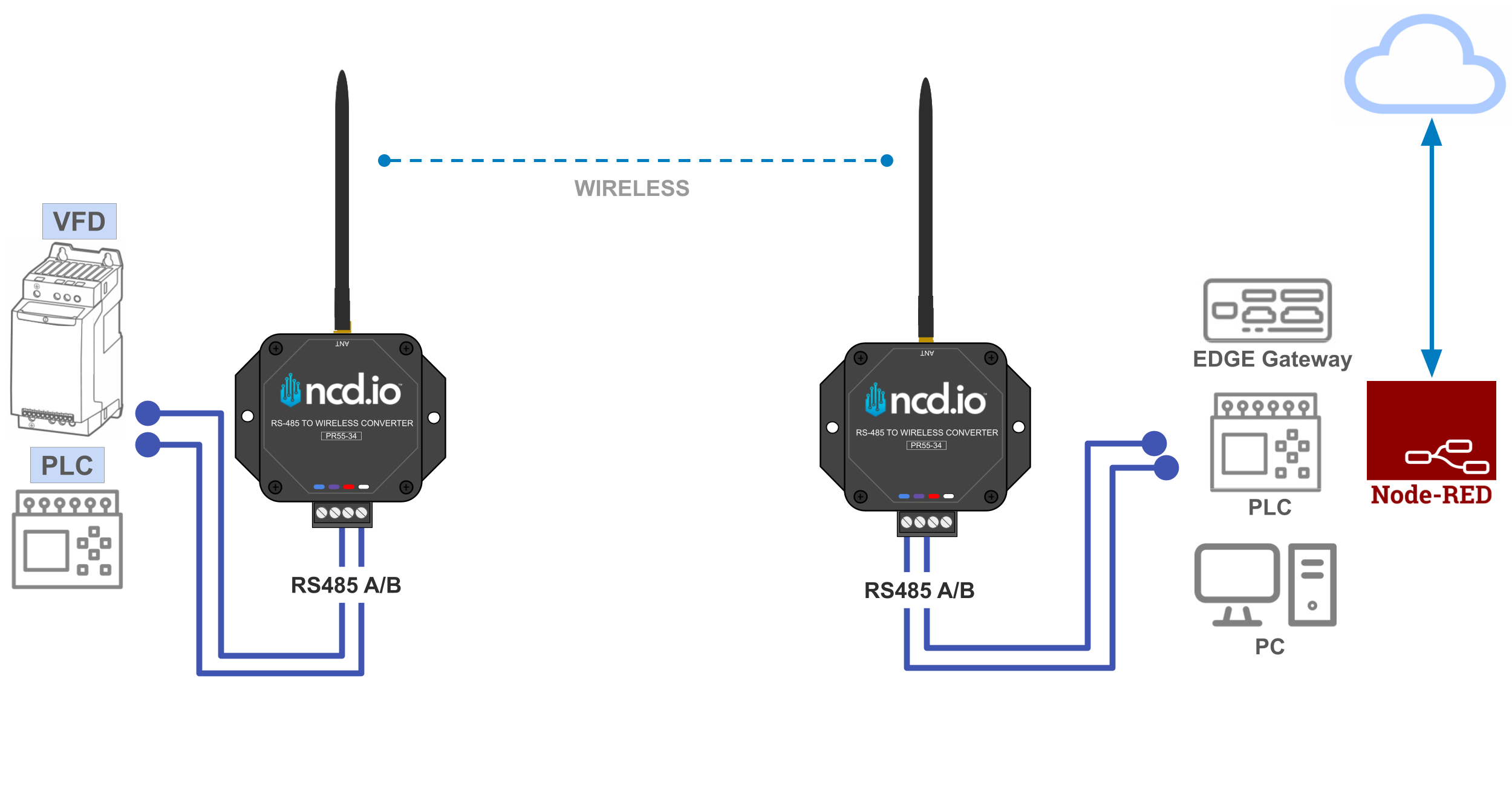
Logic Handling: The data transmission is conditioned by the connected RS485 device. It acts as a reactive “client-server” flow, perfect for request-response protocols like Modbus.
3. The Access Point: Bringing NCD Sensors to Wired Systems
Best for: Integrating NCD Wireless Sensors into an existing PLC, SCADA, or Edge Gateway.
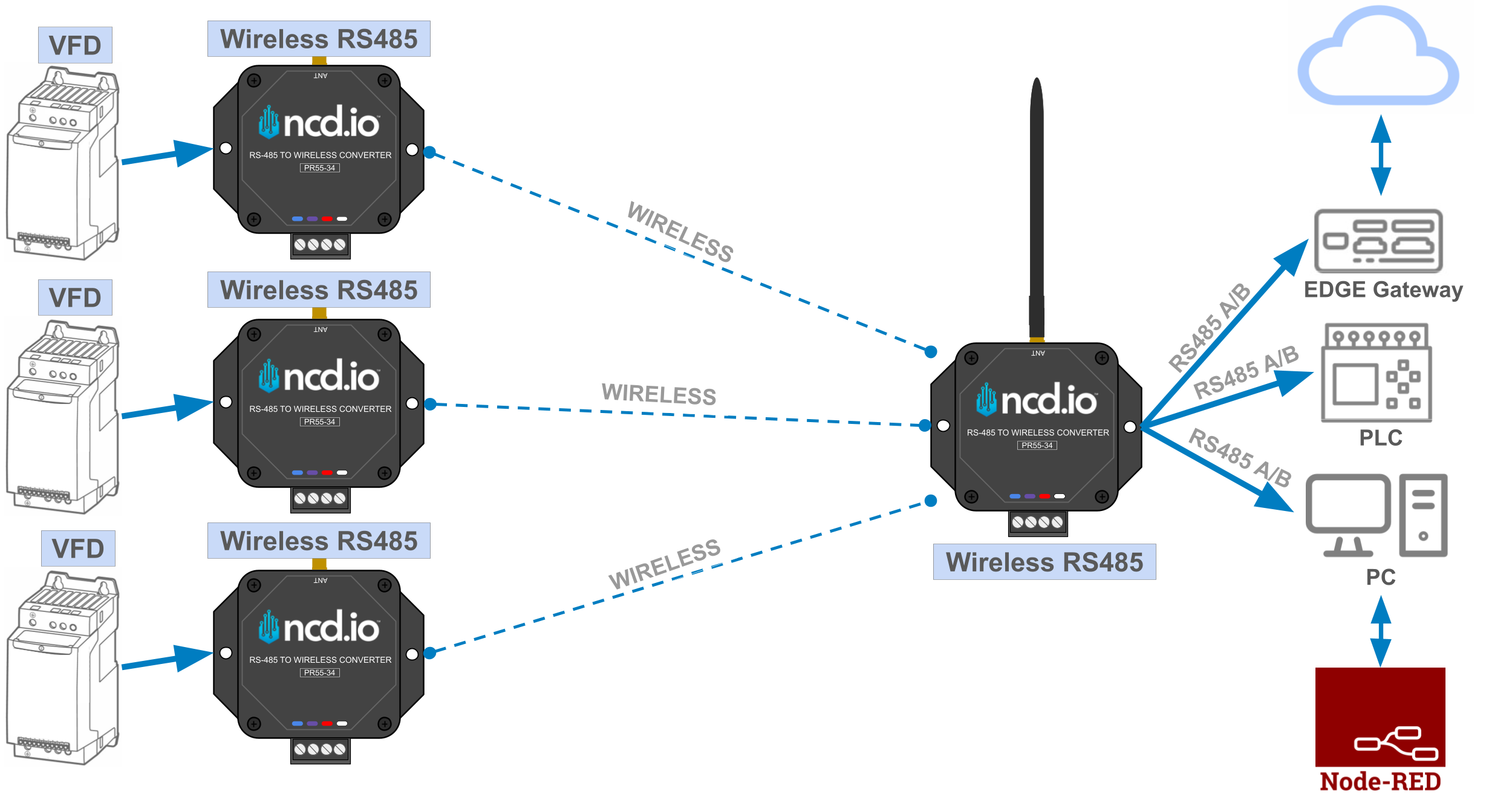
If you already have a control system that uses RS485 (like a Siemens PLC or an industrial PC), you can use the PR55-34 as a “receiver” for the entire NCD wireless sensor ecosystem.
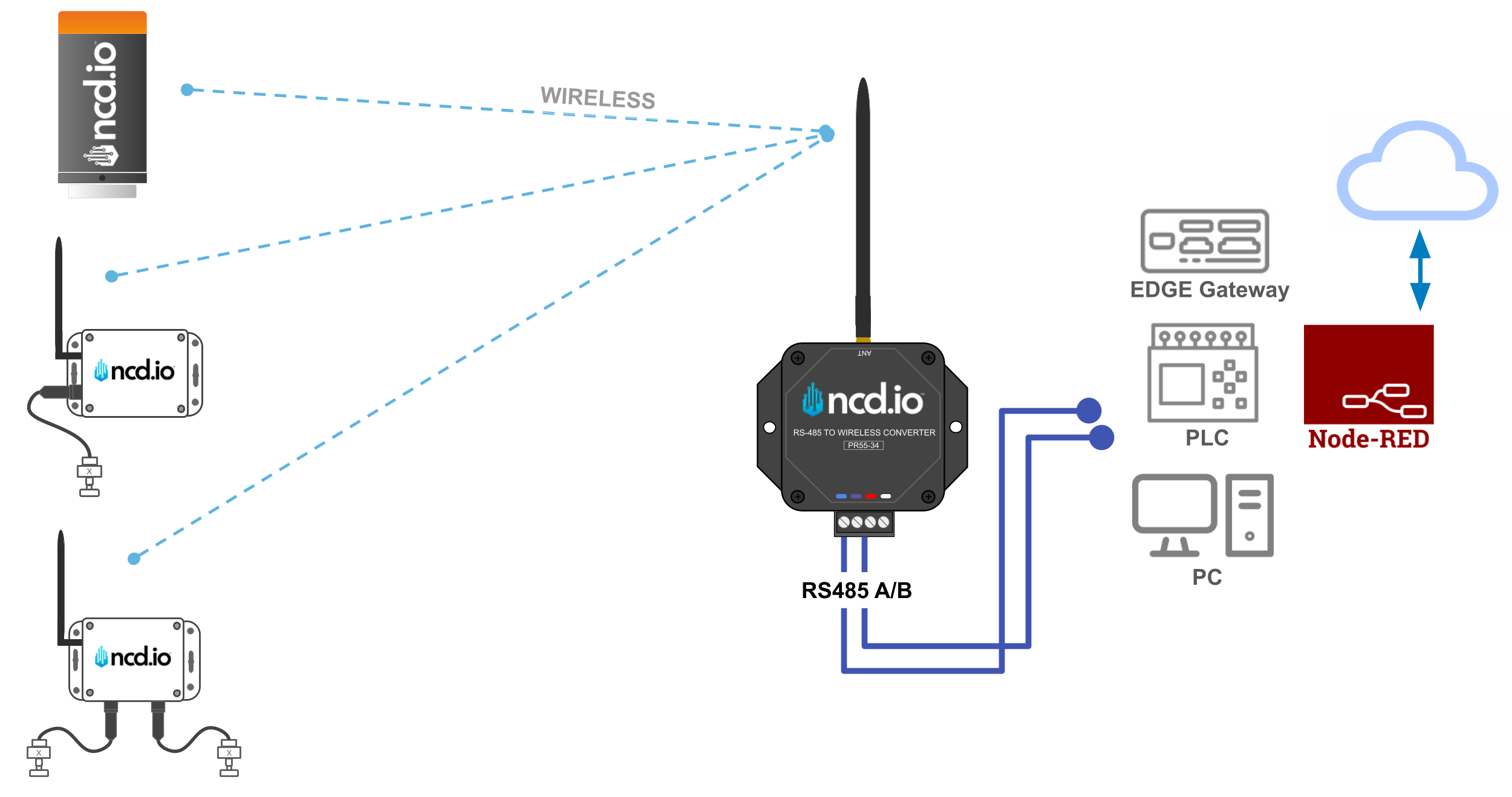
How it works: Connect the PR55-34 to your PLC’s RS485 port. When an NCD wireless vibration or temperature sensor broadcasts its data, the PR55-34 captures it and outputs the API bytes directly into your controller.
4. The Network Booster: Wireless Mesh Repeater
Best for: Large factories or facilities with heavy obstructions (metal walls, large machinery).
Every PR55-34 is built on DigiMesh® technology. This means the device isn’t just a converter; it’s a team player.
How it works: Even if you aren’t actively using the RS485 port on a specific unit, if it is powered up, it acts as a repeater. It will automatically grab data from distant sensors and “hop” it over to the gateway.
Industrial Wireless RS485 Modbus Transmitter (PR55-88F)
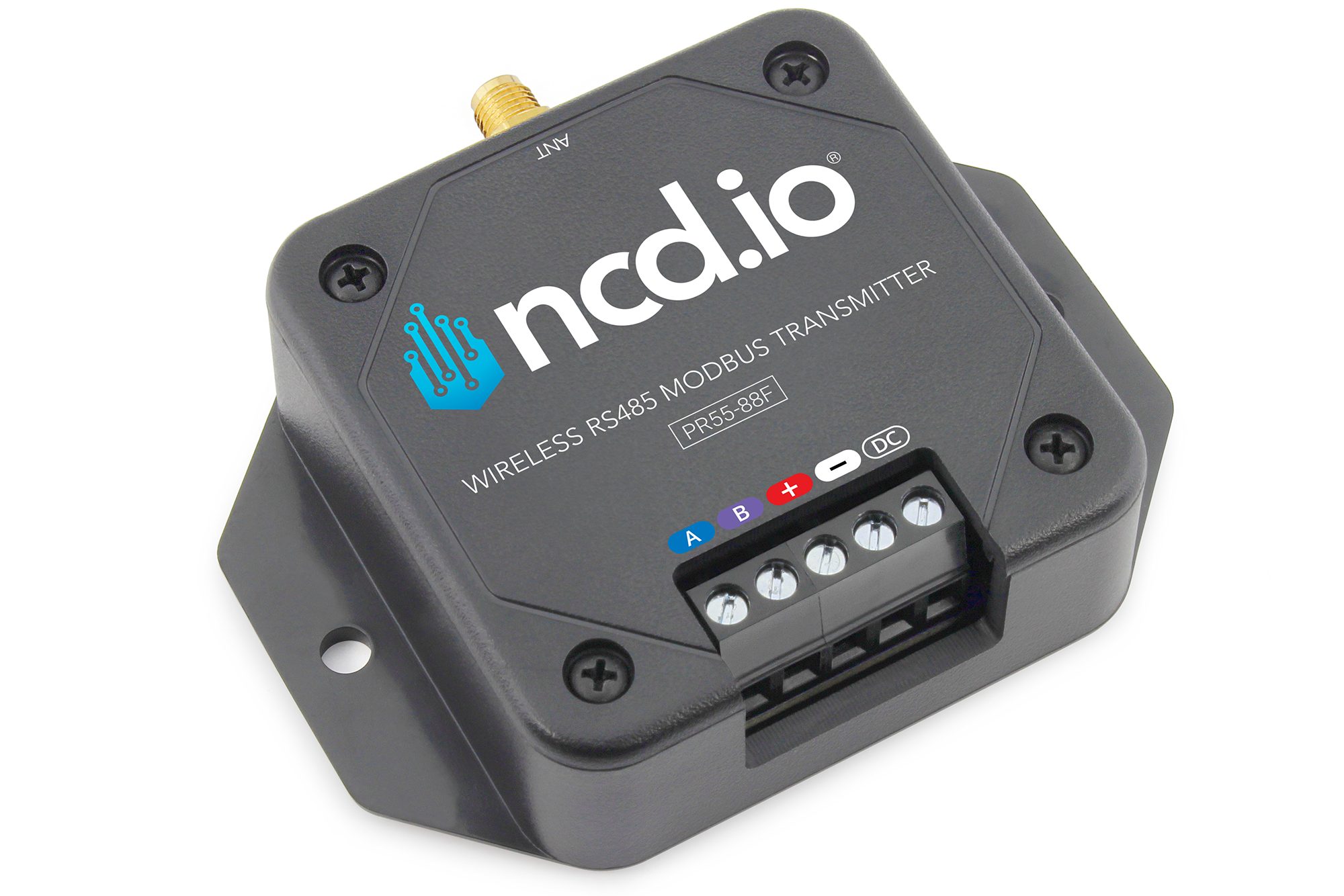
The NCD Industrial Wireless RS485 Modbus Transmitter transforms Modbus devices into seamless wireless nodes, enabling effortless integration into the NCD wireless network and eliminating the need for cumbersome wired connections. This transmitter automatically reads data from Modbus devices at user-defined intervals, transmitting the information wirelessly.
1. The Proactive Poller: How it Works
The PR55-88F is designed to be the “Master” of an RS485 loop. Instead of waiting for a command from your gateway, it follows a pre-configured schedule. To get started, you’ll connect the PR55-88F to your RS485 device and use Node-RED to set the Baud Rate, Slave ID, and the specific Registers you want to read. Once those settings are saved into the device’s internal memory, it will run autonomously—no further “orders” from the gateway required.
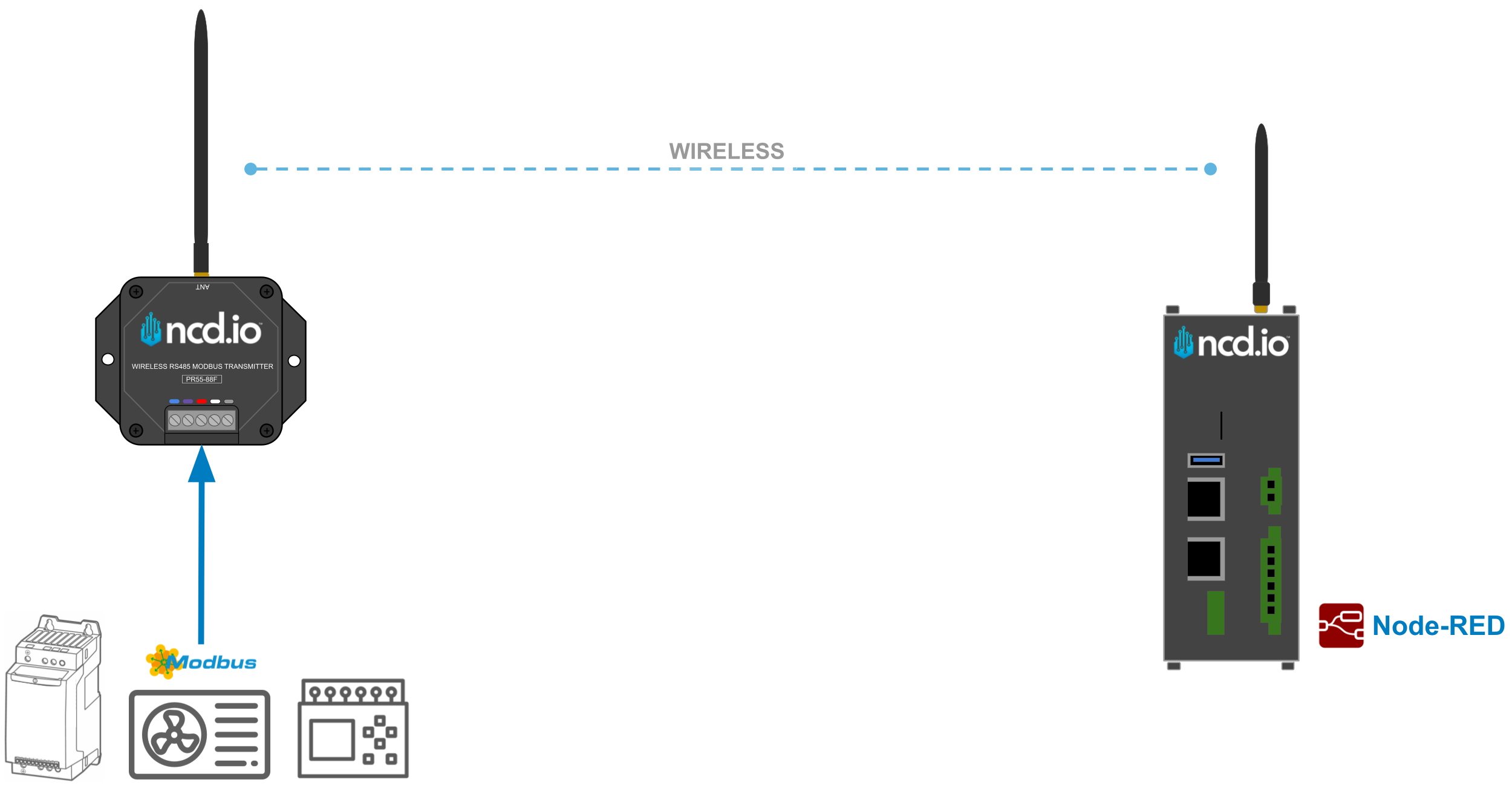
The Operational Cycle:
- Wake Up: The device wakes up from standby mode based on a user-defined interval (e.g., every 15 minutes).
- Request: It automatically sends a Modbus RTU command (Function Code 03 or 04) to your connected RS485 device.
- Listen: It waits for the RS485 device to respond with the register data.
- Transmit: It packages that Modbus data into a standard NCD wireless packet and beams it to your Gateway.
- Standby: It goes back into standby mode until the next interval.
One of the best features of the PR55-88F is that it makes a complex Modbus device look like a simple NCD sensor.
When the data arrives at your Gateway or Node-RED environment, the packet structure is identical to an NCD Temperature or Vibration sensor. It includes:
- Firmware Version
- Transmission Counter
- Sensor Type ID
- The Modbus Payload (The actual data from your registers)
This means you can use the standard NCD Node-RED libraries to manage the device, making the decoding process much faster than manual Modbus programming.
Supported Modbus Commands
This transmitter is specialized for reading data. It currently supports the two most common industrial Modbus functions:
- Read Holding Registers (Function Code 03): Used for reading configuration settings or multi-word data.
- Read Input Registers (Function Code 04): Used for reading analog inputs and measured values.
Which Device Fits Your Application?
Choosing the right device depends on whether you need a reactive link that follows commands from a central controller or an autonomous transmitter that reports data on its own schedule.
Choose the PR55-34 (Wireless Converter) if:
- You need a “Wireless Cable”: You want to replace a physical RS485 wire between two devices (like a PLC and a VFD) using two converters to act as a transparent bridge.
- The Gateway is the Master: Your application requires the Enterprise IIoT Gateway to initiate Modbus commands at specific times and wait for a response.
- You are integrating NCD Sensors into a Wired System: You need to receive data from wireless NCD sensors and output it via RS485 into a legacy PLC or SCADA system.
- You need to extend your Wireless Network: You need a device that acts as a Mesh Repeater to “hop” data from distant sensors back to the gateway.
- You need Real-Time Control: You require a constant, always-on bidirectional link for manual or high-frequency polling controlled by your own software or logic.
Choose the PR55-88F (Modbus Transmitter) if:
- You need Autonomous Monitoring: You want the device to wake up, read specific Modbus registers, and transmit them without the Gateway asking for it.
- You want a “Set it and Forget it” Setup: You prefer to configure the Slave ID, Baud Rate, and Registers once and have the device report data like a standard NCD wireless sensor.
- You are monitoring Remote Assets: Your application involves periodic data logging (e.g., every 15 minutes) for solar inverters, tank levels, or energy meters.
- You want Simple Integration: You want the Modbus data to arrive at the Gateway in a standard NCD sensor packet format (including firmware version and transmission counters) for easy decoding with NCD libraries.
RS-485 To Wireless Converter
RS485 Modbus Transmitter
Comparative Fact Summary
| Feature | PR55-34 Wireless Converter | PR55-88F Modbus Transmitter |
|---|---|---|
| Primary Role | Bidirectional Bridge / Cable Replacement | Autonomous Polling Master |
| Communication Logic | Reactive: Relays commands sent from the Gateway or another device. | Active: Automatically initiates Modbus commands based on a timer. |
| Wireless Networking | Acts as a Mesh Repeater for the NCD ecosystem. | Acts as an Endpoint Sensor; does not support bridge mode. |
| Command Support | Passes any RS485 data/protocol transparently. | Specifically supports Modbus Function Codes 03 and 04. |